
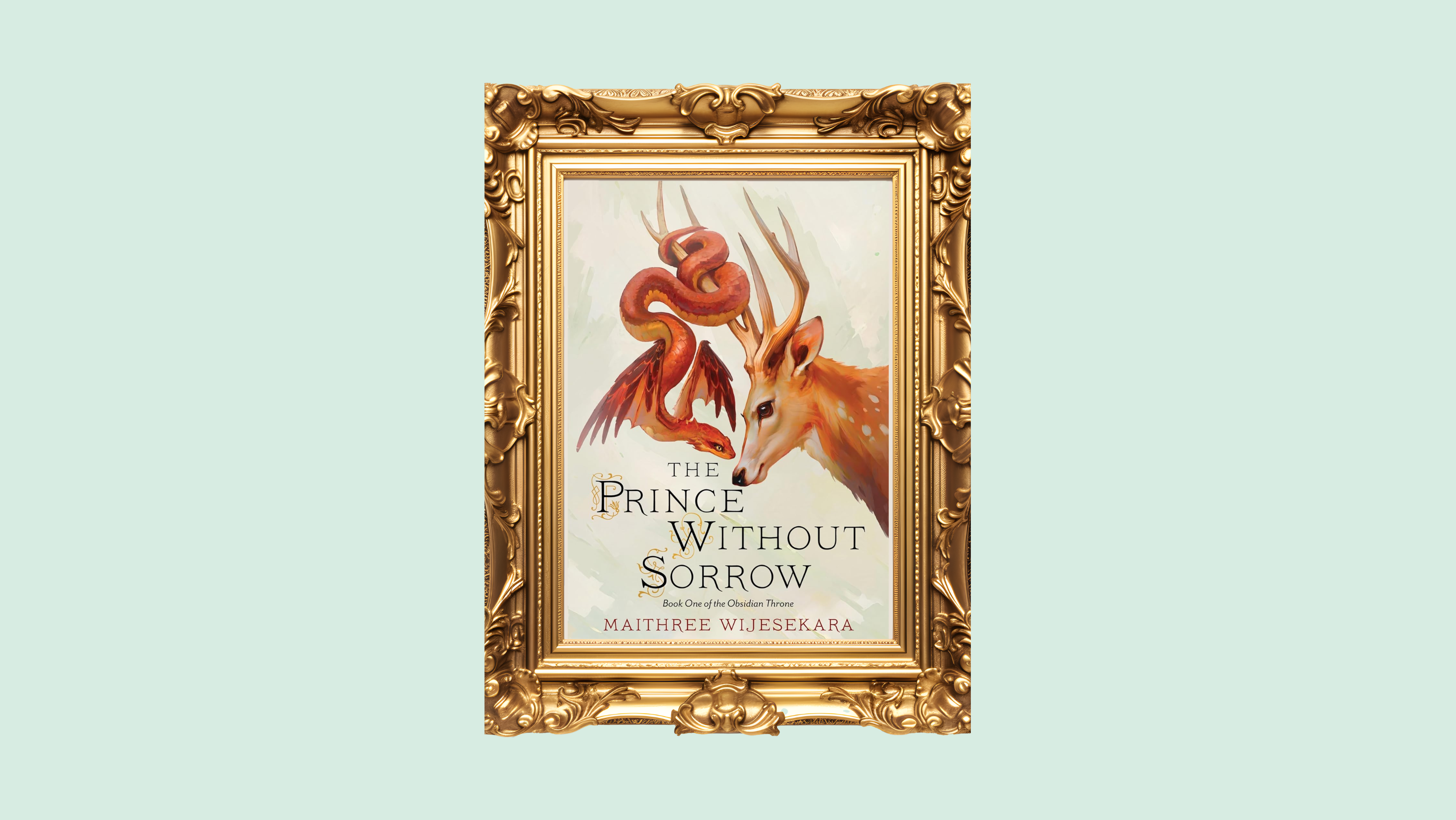
Books Right Now Presents:

I’m so excited to feature Maithree Wijesekara on Books Right Now! I’m a huge fan of her epic fantasy debut, The Prince Without Sorrow, and I’m honored to have had the opportunity to interview her.
Intro
RD: For anyone who hasn’t read The Prince Without Sorrow yet, how would you describe your book in one sentence?
MW: A pacifist prince and a revenge-driven witch try to dismantle his father’s brutal empire.
A Deep Dive into The Prince Without Sorrow
RD: What inspired you to write The Prince Without Sorrow?
MW: The Prince Without Sorrow is very (very) loosely inspired by Emperor Ashoka of the Mauryan Dynasty of Ancient India. He was a notable figure in Buddhist history, being known from his marked shift from violence to nonviolence. You can even track this change through his epithets: he goes from Ashoka the Cruel/Fierce to Ashoka the Righteous/Pious.
I was always fascinated by this ideological shift. What led him to change course completely? Was the transition to nonviolence difficult? Did he ever feel immense guilt for the violence he enacted and was he ever forgiven? Was it harder or easier to turn to nonviolence? That last question was what led the Prince Ashoka of my story to wander into my mind and then refuse to leave. My fictional Prince Ashoka took the historical Emperor’s arc and reversed it. People ask why I didn’t follow the original violence-to-nonviolence arc, and my answer is that I find stories about corruption of the self a bit more fascinating to explore.
Another inspiration for the novel is the 1997 Studio Ghibli film Princess Mononoke. The film is a bloody and meditative exploration of the relationship humans have with nature, which is personified in the form of eerie wild gods and little spirits. If you’ve seen the film, you’ll be able to see how it’s influenced The Prince Without Sorrow, especially with regards to the spirits. If you haven’t seen the film, I highly recommend it!
RD: How did you research the Emperor Ashoka for your book, and are there any sources you would recommend to readers who want to learn more?
MW: As a historical figure, there’s not a lot of information on Emperor Ashoka. Much of his life is mixed with myth and legend. Pillars still stand throughout the Indian subcontinent that bear his edicts. At the same time, there are tales of him killing 99 brothers to take the throne for himself or turning into a snake before he died.
Initially, I relied on stories and secondary sources: namely, the Ashokavadana (which glorified him, so I had to take what I read with a grain of salt) to get a background on the emperor. Ultimately, I ended up taking a lot of creative liberties. While the story of Prince Ashoka in The Prince Without Sorrow isn’t the same as Emperor Ashoka (the novel isn’t historical in the slightest), there are nods here and there to his real-life counterpart that I hope those who know of him will appreciate.
RD: What did your publishing journey look like from submission to final book?
MW: My submission period was fast. Honestly, I lucked out there. My wonderful agent, Maddy, and I went on submission to editors in late March 2023.
I was told that it was usually a waiting game, and that I should distract myself. Distraction came in the form of a solo-trip to Japan that just so happened to coincide with the date that we went on sub. We got an offer the next day, and then a few more as the week progressed! I was in shock and extremely excited. I got to meet with some of the offering editors on Zoom, who were all extremely lovely. In the end, I chose to publish with Harper Voyager UK.
A couple of months after acquisition, my editor, Natasha, sent me an edit letter for the manuscript that my agent and I originally submitted. The manuscript went through developmental edits, copy edits, line edits and proofreading. It was an interesting change for me. I’d written The Prince Without Sorrow leisurely during the 2020 lockdown. Now that the book was set to be published, there were deadlines to adhere to. A hobby had become a job.
Cover-wise, the UK publishing team sent me portfolios of a few different illustrators. I gave my two cents on whose art style I preferred. Luckily, we all seemed to be on the same page. The illustrator, Julian De Narvaez, created the beautiful blue cover with the tiger for the first book. On the North American side, I gave the Voyager US team a list of illustrators whose art styles I liked, and we ended up choosing the wonderful Tasia M.S. She created the stunning cover of the deer and baby winged serpent. I am so grateful to have such great covers for my debut novel!
Physical and e-ARCs were released around June/July 2024, with the book being officially published the following year (March for North America, April for the UK and Commonwealth). I didn’t realise how much behind-the-scenes work there was. It truly takes a village to get a book from manuscript to a copy on the shelf!
RD: Who would be your dream cast for a film adaptation of The Prince Without Sorrow?
MW: You’d think this would be an easy question, but it’s the total opposite. To this day, the dream cast question remains one of the hardest to answer. I think it’s because I can never imagine character faces properly. I know what features they have, but they’re always blurry in my mind’s eye. So, at this stage, I don’t have a dream cast. I do love to hear other people’s fancasts, though!
RD: What do you think are Aarya and Rahil’s theme songs?
MW: Ooh, this is a great question! For Rahil, I’d pick Nobody by OneRepublic. For Aarya, I’d choose The Family Jewels by MARINA and Weird Hills by Janani K. Jha.
RD: Who is your favorite of your mayakari (witches)?
MW: I’m going to be so boring with my answer: Shakti. She’s my figurative child; an absolute gremlin (said affectionately).
Meet the Storyteller
RD: What were your favorite books growing up?
MW: As a kid, I absolutely loved the W.I.T.C.H. comics (best news I found out after finishing the comics was that it was adapted into a cartoon). The Percy Jackson and the Olympians series is also near and dear to my heart. I think I picked up using humour as a defense mechanism from Percy.
RD: Who are your favorite authors?
MW: I have so many! Off the top of my head: Arundhati Roy, Shehan Karunatilaka, Fonda Lee, Madeleine Miller.
RD: How do your culture and your identity influence your writing?
MW: I was raised Buddhist, so I wanted to incorporate some of the philosophies I grew up with into the story. For example, much of the mayakari/witch code and way of thinking is inspired by Buddhist philosophy. Along with nonviolence, the mayakari claim that cursing the living or raising the dead results in ‘bad karma’ is loosely based on the belief that the actions you take in this life will affect the next. Hurting others will cause hurt to yourself, so to speak.
You will find mentions of other concepts throughout the book. Fate or destiny isn’t something that people believe in. Instead, belief centers around laws of cause-and-effect. At one point, a mayakari refers to the concept of anatta (the not-self). In Buddhism, there is no permanent, unchanging soul. Rather, what we perceive as ‘the self’ is composed of ever-shifting aggregates. Who you are is always in flux. I find these philosophies to be extremely interesting, and I hope readers do as well.
RD: What is the most important thing you’ve learned during your writing career so far?
MW: That it’s okay to ask for more time to work on your edits! I was terrified to ask the first time around and thought I was being an inconvenience. But I later came to learn that requesting an extension on your deadline is common.
RD: Who are some of your favorite fictional witches?
MW: Kiki from the Studio Ghibli movie Kiki’s Flying Delivery Service, the Owens sisters in Practical Magic (I love that house), and Mika Moon in Sangu Mandanna’s The Very Secret Society of Irregular Witches, to name a few!
RD: What is the best book you’ve read this year (apart from your own of course)?
MW: A bit late to the game with this one, but White Tears/Brown Scars by Ruby Hamad.
What’s Next
RD: What’s next for you? I’d love to learn more about the second installment of the Obsidian Throne trilogy and any other projects you may be working on.
MW: The second book of the Obsidian Throne trilogy, The Witch Without Memory, will be coming out in April next year! I’m super excited for its release. My agent told me last year that writing the second book will be harder than the first. I didn’t fully believe her, but she was correct. I think it was hard for me because, unlike The Prince Without Sorrow, I didn’t have all the time in the world to write. There were deadlines to follow, and I freaked out whenever I hit a writing block. Imposter syndrome came in hard, too, but that might just be a vice of every career you make a start in. Got there in the end, though.
Currently, I’m editing Book 3 (which shall remain untitled for now). It’s at what I call the Primordial Soup Stage, mostly because it’s a mess. The good thing is, I can only go up from here!
Thank you for reading!
More About Maithree Wijesekara

Maithree Wijesekara [pronounced “MY – THREE”] is an Australian-Sri Lankan author based in Melbourne. Graduating with a Masters in Dentistry in 2021, she splits her time between telling people to please brush their teeth, and writing stories inspired by the fantastical and the real world.

Leave a Reply