
Books Right Now Presents:

I’m so excited to feature Lauren J.A. Bear on Books Right Now! I’m a huge fan of her Greek and Roman mythology retellings, and I’m honored to have had the opportunity to interview her.
Intro
RD: You’ve authored three novels so far, two of which are retellings of Greek mythology and one of Roman mythology. What draws you to the ancient world?
LB: The stories are wild! Magic and sex and vengeance, everything in extreme. But mostly I love the sense of possibility. Salman Rushdie spoke about this when he came to Seattle. You can retell the main plot of Orpheus and Eurydice in 300 words, and yet, this story has inspired countless – detailed! – reimaginings over the centuries. Reinterpreting old stories allows the oral tradition to continue, to adapt to a new generation of tellers and listeners, and I find that participating in this tradition helps me feel connected to people over time and place.
RD: Are there any other pantheons or mythologies you feel particularly drawn to?
LB: I really appreciate how Silvia Moreno-Garcia has championed the mythology of the Maya in her work. Gods of Jade and Shadow is so wonderful. Also, Naomi Novik has done such wonderful work with eastern European mythologies – particularly the Polish and Slavic folklore in Uprooted and Spinning Silver. Both of these writers are masterful at creating atmosphere.
RD: Which authors inspire you most in your own journey as an author?
LB: Ursula K. Le Guin is such an icon for me, particularly in the way she represented and championed the literary value of genre fiction. Of the authors currently writing, I will read anything by Maggie O’Farrell, S.A. Cosby, Stephen Graham Jones, Marie-Helene Bertino, Ann Patchett…
I read everything, and find joy and value in all genres. I am a proud promiscuous reader!
What were some of your favorite books growing up?
LB: The Dealing with Dragons series got me hooked on fantasy – thank you to the Long Beach librarian who passed me that book! I was also obsessed with the American Girl books – Felicity was my favorite – and the dark humor of Roald Dahl. When I was in middle school, I adored Mara, Daughter of the Nile and Wuthering Heights.
RD: What are your favorite bookstores to visit?
LB: Third Place Books in Seattle! I love all their locations, but have a special place in my heart for Seward Park. I grew up going to the Barnes and Noble at Long Beach Towne Center in California. And when I’m back east visiting family, I love Edgartown Books.
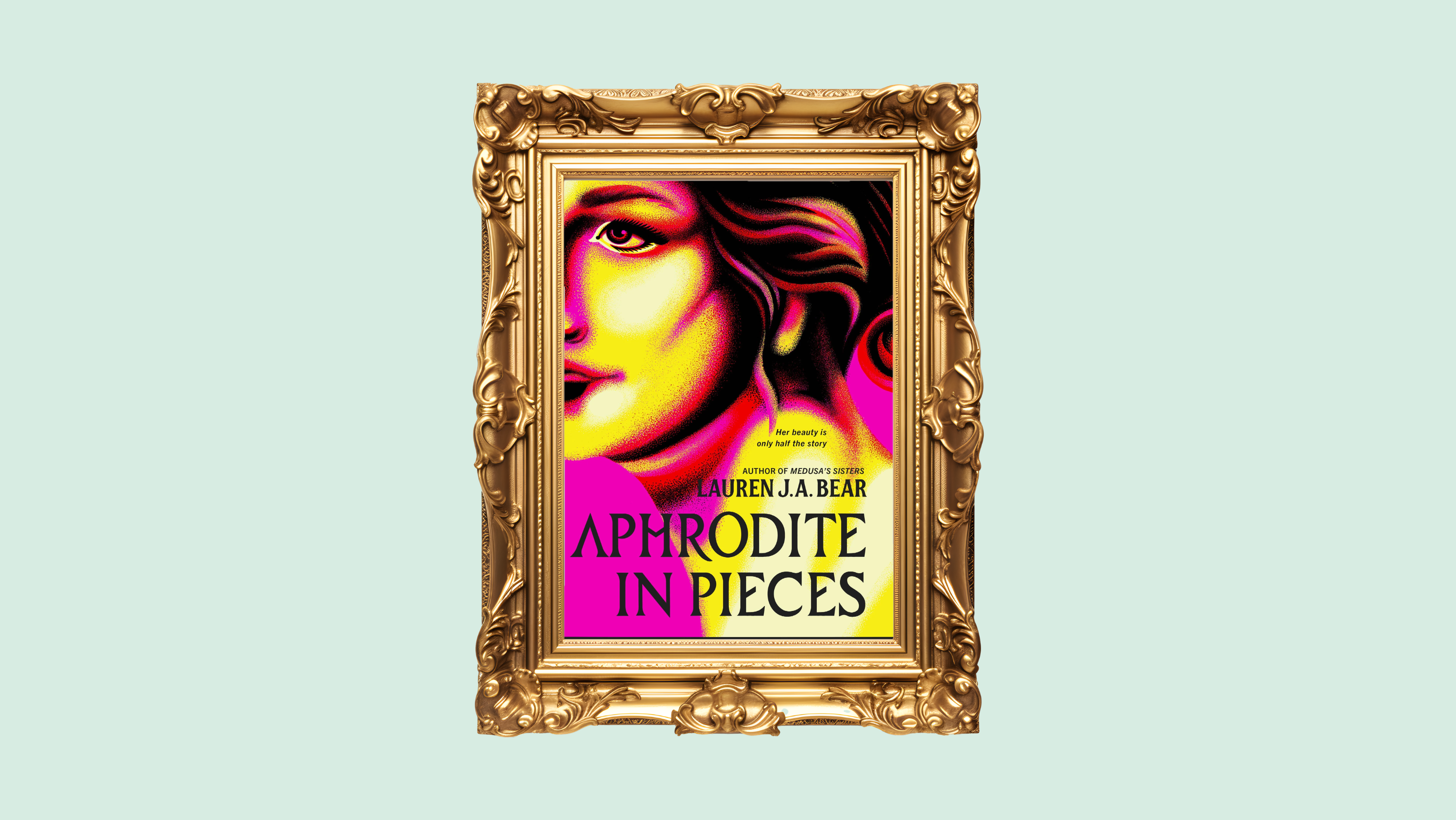
Aphrodite in Pieces
RD: For anyone who hasn’t read Aphrodite in Pieces yet, how would you describe your book in one or two sentences?
LB: This is Aphrodite in her “one night only!” big reveal. As she poses for her likeness, she tells her scintillating life story to the artist memorializing her in stone.
RD: I almost feel as though this book should be required reading for everyone, especially given the way you’ve captured so many of the intricacies and ironies of womanhood. What are some of the themes or messages you hope readers take away from this book?
LB: Well, first of all, thank you! What a wonderful compliment! This is a book about love, obviously, but self-love above all. Aphrodite struggles to forgive herself; she accepts the version of herself created by others. But in order to love others harder, to love them better, she needs to stand proudly in her own identity.
That’s what I wish to impart to women – we are worthy of love, just the way we are.
RD: The romance between Aphrodite and Ares is so beautifully rendered in its passion, love, and complications. How did you approach writing this relationship?
LB: I was inspired by the tumultuous relationship between Richard Burton and Elizabeth Taylor – their affair, their passion, their volatility. Their imperfect legend. I also read a lot of romantasy to prepare, and I knew I wanted to play with reader expectations: in this book, the girl pursues the boy. Aphrodite is the cocky, swaggering lothario, not Ares. And he’s not the perfect romantic hero – he’s a mess, too.
They are flawed individuals who find connection in a flawed world and continue to try, to choose each other again and again, to adjust and adapt. Because that’s what lasting love requires.
RD: Who were the most fun characters to write in this story?
LB: Aphrodite was a blast. I would crack myself up writing her lines! I really enjoyed creating her friendship with Apollo. They are the duo you join at happy hour for all the hottest tea.
RD: Since this is your third published novel, are there any lessons you learned from writing or publishing the first two novels that you employed here?
LB: I’ve stopped worrying so much about demonstrating what I can do. Just because I know these esoteric vocabulary words doesn’t mean I need to use them. Just because I did insane amounts of research doesn’t mean I need to include every fun fact. I think I’m learning restraint – the beauty and possibility of saying less.
Mother of Rome
RD: For anyone who hasn’t read Mother of Rome yet, how would you describe your book in one or two sentences?
LB: This is the story of Rhea Silvia, the mother of Romulus and Remus, and how her sacrifices and choices shaped Rome’s destiny.
RD: What drew you to Rhea Silvia’s story?
LB: The Capitoline wolf – the she-wolf nursing infant twins – has always tugged at my imagination. It is an image that persists, and it jump started my research. When the primary source materials didn’t fully explain what happened to Rhea Silvia after the boys were born, I knew her story needed a proper ending. A woman’s worth shouldn’t be measured by her womb.
RD: Mother of Rome is, without exaggeration, the best motherhood book I’ve ever read. How did you, from a craft perspective, approach motherhood as such a central and driving element of the story?
LB: I’ve actually never discussed this in an interview before, Rashi, but here I go. My mother was diagnosed with Alzheimer’s while I was drafting this book. Focusing so intently upon motherhood broke my heart, but it was also a cathartic experience. I had this incredible opportunity to examine matriarchal legacy and inheritance, how we remember each other and honor the ancestral cycle.
I’m in the middle of my “sandwich generation” years – both a daughter and a mother to young children. So much of Rhea’s fear and need mirrored my own soul. It was deeply personal.
RD: If you could give Rhea Silvia one piece of advice at the very beginning of your book, what would it be?
LB: Umm, use protection? But then again, if she didn’t get pregnant, there wouldn’t be much of a story…
Medusa’s Sisters
RD: For anyone who hasn’t read Medusa’s Sisters yet, how would you describe your book in one or two sentences?
LB: It’s the Medusa story, told by the two who knew her best, from their birth beneath the waves to their life after her tragic death.
RD: While Medusa is, of course, an important presence in the novel, the story is really centered on Euryale and Stheno. Why did you decide to focus on them?
LB: Because although they were punished together, Medusa is famous while Stheno and Euryale are not. The concept of collective guilt compels me, as well as the idea that each sister might react to their circumstances – and interpret them – differently. The more I considered this triangle of personalities, the more I realized its Shakespearean qualities – the tragic miscommunications, the mismanaged intentions.
RD: What was the hardest scene to write in this book, and what was the easiest?
LB: Oh, by far the most difficult scene was the one in Athena’s temple. While Gorgons might be a myth, sexual violence, unfortunately, is not.
The scenes with Orion were the easiest for my youngest son had just been born and he was the best inspiration.
RD: How did you approach writing sisterhood in this novel?
LB: I don’t have a biological sister, but my girlfriends and my cousins fill that space for me. I believe strongly in the sanctity of female relationships and embrace their complexity. Behind every strong woman is a crew of other strong women who have her back.
What’s Next
RD: What’s next for you? I’d love to learn more about any other projects you may be working on that you can share at this time.
LB: I’m not sure how much my agent would want me to share, but I am working on another feminist retelling of an entirely different type of classic. And at some point I would love to write a western!
Thank you for reading!
More About Lauren J.A. Bear

Lauren was born in Boston and raised in Long Beach. After studying English at UCLA and education at Loyola Marymount University, worked for a decade as a middle-school teacher focused on literacy and humanities. Lauren lives in Seattle with her husband and three young children where she enjoys crossword puzzles and being on or near the water without getting wet. She is the author or Medusa’s Sisters, Mother of Rome, and Aphrodite in Pieces
Leave a Reply