
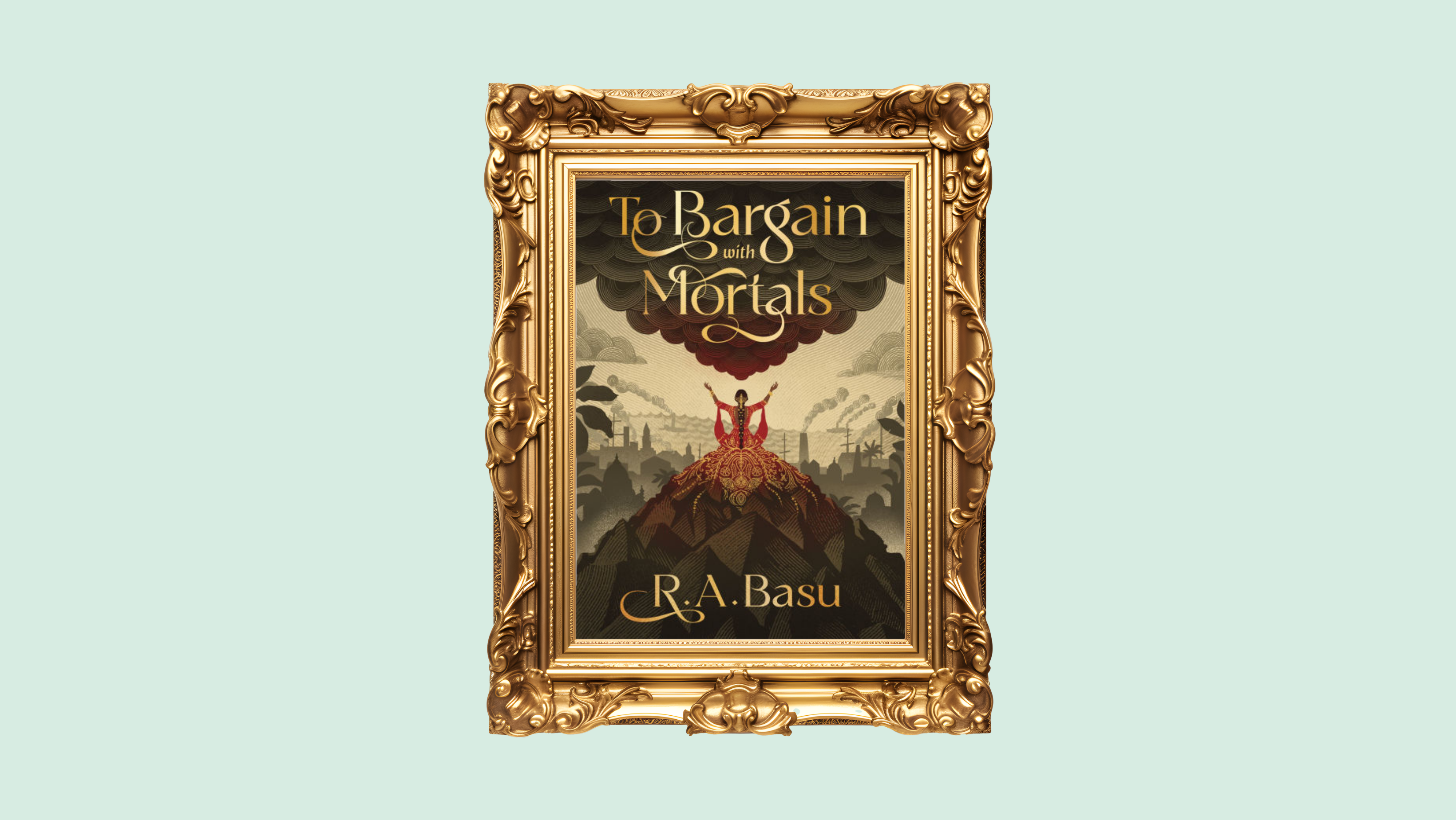
Books Right Now Presents:
I am so excited to feature R.A. Basu on Books Right Now! I absolutely love her debut historical fantasy novel, To Bargain with Mortals, and I’m honored to have had the opportunity to interview her!
Intro
RD: For anyone who hasn’t read To Bargain with Mortals yet, how would you describe your book in one sentence?
RAB: I’m getting better at this elevator pitch: the adopted heiress of a colonized island teams up with a notorious criminal to outmaneuver her treacherous fiancé and reclaim her heritage.
A Deep Dive into To Bargain with Mortals
RD: What inspired you to write To Bargain with Mortals?
RAB: The easy answer is that Jimin inspired To Bargain with Mortals. My friend sent me a picture of Jimin, and I thought it was giving mafia boss so I wrote a couple paragraphs about POV: You’ve been kidnapped by a mafia boss. There’s shadows of that original text message still in the book today.
Originally it was supposed to be a Hades and Persephone retelling, except I am so bad at retellings. The story I wanted to tell was not actually a retelling. I was just leveraging aesthetics. At some point I just departed completely from the original myth and went my own way, but there’s still little hints of what it used to be in the book. The names of the brothers share the original first letter of all of the big three Greek gods: so Hasan is inspired by Hades, Paranjay by Poseidon, and Zeyar by Zeus.
One of the other things that I was thinking about was: brown girl rebellion and what that means. In a lot of media you’ll see, if a brown girl wants to rebel, she moves towards whiteness. At least in western society, whiteness is the norm. Whiteness is the standard. It’s almost subconscious. Sometimes you’ll see people describe characters by their skin colors unless they’re a white person. So whiteness is default.
When you say you’re rebelling, but you’re really moving towards whiteness, is that a rebellion? Who are you defying by doing that? I wanted to flip it on its head, and say instead of being rebellious and dating a white guy, she’s going be rebellious and get in touch with her culture.
RD: What did your research and drafting process look like?
RAB: I would say there were probably four or five drafts involved in this book. The first couple were that romantic Hades and Persephone flop retelling, where the only retelling part is the kidnapping. The third draft was my Pitch Wars draft, where we probably did two iterations. We made it more political, more action focused. I rewrote all of Poppy’s point of view in first person, and then Hasan’s was in third person.
Then, I was querying the book, trying to get an agent. One of the agents gave me a Revise and Resubmit. The main piece of feedback was that she didn’t think first and third were working so I made the whole thing third person.
I resubmitted that manuscript to whatever agents had the other version, and that was the version I submitted to Emma during Bindery’s Pitch Fest. The edits after that were all with Bindery’s Developmental Editor. He helped me tighten up the magic system, among a bunch of different things.
RD: I’d love to learn more about Bindery Books specifically. I’ve seen a lot about how the process of publishing a book is very interactive, and I’d love to learn more about this.
RAB: In our case, Emma puts out a video once a month, or she’ll make posts quite regularly with behind the scenes. Recently she posted a graveyard of covers that we had considered.
Bindery cares a lot about whether you as the author are okay with what’s going on. I honestly found it really wholesome. They were in it for the love of the books. It wasn’t about how much money this book was going to make them.
RD: Who would be your dream cast for a film adaptation of To Bargain with Mortals?
RAB: I’m so bad with faces when I’m writing characters. However, there are two specifically that I think would work really well. I think Simone Ashley would make a great Harithi. The way she acts as Kate in Bridgerton, I think her attitude would just be great for Harithi.
Then, Rahul Kohli from Midnight Mass for Paranjay. If anyone else wants to fan cast anybody, I’m open to suggestions.
RD: What songs would feature on Poppy and Hasan’s Spotify Wrapped (if Spotify or streaming or cell phones existed in their world)?
RAB: For Poppy, I picked Castle by Halsey, Apple by Charli xcx, and then Nobody’s Son by Sabrina Carpenter. For Hassan, I picked Spring Breakers by Charli xcx, Power is Power by SZA, The Weeknd, and Travis Scott. Then, this is inspired by Zohran Mamdani’s win: Dhoom Machale.
RD: What’s one recent release that you think Poppy would love?
RAB: I haven’t seen Wicked: For Good yet, but I feel like Poppy would love Wicked so I’m assuming she would love Wicked: For Good.
This hasn’t come out yet, but I’m reading Burn The Sea by Mona Tewari right now. It’s all I can think about, and I feel like Poppy would love this book because the women are all badasses. The setting is so rich; it’s got great food descriptions. It’s not out yet, but when it’s out that’ll be her favorite book.
Meet the Storyteller
RD: What were your favorite books growing up?
RAB: In my younger years, I was super into Warrior Cats. I read all the segments that were out at the time.
Warrior Cats is starter pack Game of Thrones. I feel like if you’re twelve, it’s Game of Thrones. You’ve got the houses and the clans. There’s all this forbidden romance. There’s battles, there’s prophecies, and they even have a whole religion with Star Clan. Honestly, if I had the time today, I would go back and re-read all of them plus the ones they put out since I became an adult.
I was also really into Percy Jackson and the Olympians. That was a big obsession of mine. I know the movie was bad, but that was the beginning of my Logan Lerman era so it was good for something. I was also super into Eragon.
Then as I got older, in terms of YA series, I was really into the His Fair Assassins trilogy. Six of Crows was another obsession. I still think that’s my favorite series set in that universe.
I was a big John Green fan in high school. Then, The Hunger Games and Divergent were also big. It’s a decade old series, but I still don’t think I’ll ever be over the way Divergent ended. To this day, I can’t reread it because I’m so salty about the ending.
RD: Who are your favorite South Asian authors?
RAB: Big Tasha Suri fan – my favorite book of hers still remains Empire of Sand. I know that’s her first book, but the love interest in that book is just so soft. I fear that I have a really soft spot for that book in particular because of the love interest.
Vaishnavi Patel – she’s great! She was actually one of my mentors for To Bargain with Mortals when I was in Pitch Wars for it. Sarah Mughal Rana was the other one. She’s also great. She has a YA contemporary out right now and then her adult fantasy debut comes out in December so that’s pretty exciting.
Sabaa Tahir – I feel like she’s been in the game forever. All My Rage was so good. I was upset about it for days and days. I get upset thinking about it for too long.
S. Hati – she was in my Pitch Wars class. She’s also really pivotal to my publishing journey because her referral to her agent is why I have an agent right now. So shout out to S. Hati!
Then, Alina Khawaja writes romance novels. She and I have been longtime friends as well. Also, M.T. Khan. I don’t read a lot of middle grade anymore, just because it’s not my cup of tea. However, I feel like M.T. Khan’s middle grade usually has a social issue with the core of it, which makes it interesting to me.
RD: What’s your favorite Nintendo Switch game to play right now?
RAB: Right now I’m back into Animal Crossing because they’re coming out with that new update. I haven’t been on my island in a hot minute. I came back and there were roaches in my house in the game. It’s a whole situation. Now I have to clean everything up and get it ready because I want to play the new stuff.
RD: How do your culture and your identity influence your writing?
RAB: Poppy probably represents, most strongly, my connection to my culture. When I was super young, the town where I lived was still predominantly white. When I went to university, that was the first time that I was in a predominantly brown space, and suddenly I was jealous of all these other kids who had these really strong ties to their cultures, could speak two or three languages, and really understood the history of their people. They felt more grounded in their culture than I was. That was how that part of my identity influenced her angst.
The other thing is that I tried to incorporate little bits of what I enjoy about my culture into the book for world building. There’s a lot of food in the book, and they are all pretty much like foods that I like to eat.
I’ve made a few trips to India, just to see family friends. There was a year where my parents took us to different parts of India to show us some of the forts and the Taj Mahal. I tried to include bits of that trip as part of the ambiance.
RD: What is the most important thing you’ve learned during your writing career so far?
RAB: It’s the importance of not giving up on yourself. There’s a difference between self rejection and knowing when you’ve done your best, and it’s time to let go.
RD: What advice would you give other South Asian authors who are navigating the publishing process?
RAB: When you’re writing whatever story you’re trying to tell, don’t worry about trying to represent the entirety of the culture. It’s just way too vast. That used to stress me out a lot. I would be mindful of your biases, but you don’t have to cover everything. I don’t think there’s a bingo card of all the points you have to hit to write a real South Asian book. Just go ahead and do your thing.
What’s Next
RD: What’s next for you? I’d love to learn more about the second installment of the Reckoning Storm duology and any other projects you may be working on.
RAB: We’re starting edits for book two. I don’t know how much of the original draft of book two is going to survive. Some people write a first draft and it’s pretty true to what their final draft is going to be like but for me, I think it’ll be a pretty decent edit.
So the question I’m trying to answer with book two is: can you change the system from within? It’s hard to explain without spoiling all of book one, but I don’t think that this is the last they have to say.
Poppy’s got more work to do.
Thank you for reading! This interview has been edited for length and clarity. The full version of this interview is available on Spotify.
More About R.A. Basu

R. A. Basu is an Indian Canadian author from Ontario who works in digital development by day and binge reads novels by night. When she’s not writing, she can be found playing on the Nintendo Switch, fighting for her life in a Pilates class, or looking for the best matcha in her city.
Leave a Reply