
Books Right Now Presents:

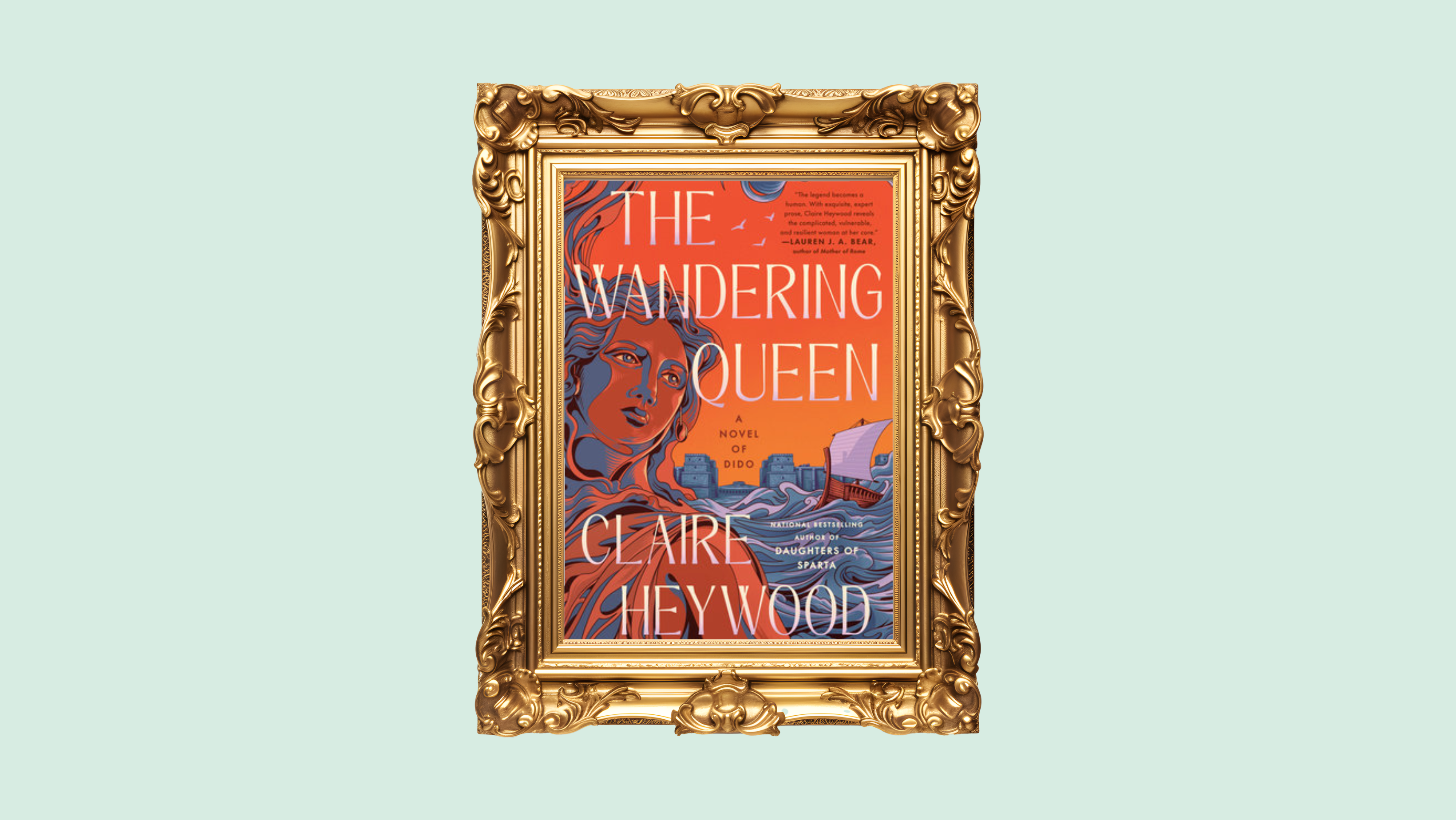
I’m so excited to feature Claire Heywood on Books Right Now! I’m a huge fan of her Greek mythology retelling, The Wandering Queen, and I’m honored to have had the opportunity to interview her.
Intro
RD: For anyone who hasn’t read The Wandering Queen yet, how would you describe your book in one sentence?
CH: The Wandering Queen is a historical fiction retelling of the legend of Queen Dido, who crosses the sea to build a home for her people, and whose life is caught in a balance between power and love.
A Deep Dive into The Wandering Queen
RD: What drew you to Dido’s story?
CH: Any student of Latin is likely to have come across Dido, since she appears in the most famous and frequently studied work of Latin literature, Virgil’s Aeneid. She is also, arguably, the most compelling character of this great epic poem, despite only appearing in the first few books. So, I had ‘known’ Dido from early on in my classical studies, and she left a lasting impression on me.
The reason I turned to her story for my third novel is because I had written two books about women with very little control over their lives, very little power or agency beyond what they were able to scrape out for themselves. Dido, on the other hand, is a rarity in ancient fiction. She is a woman with real power, who is not villainised for wielding that power. That is an attractive subject for a female-focused mythology retelling, but also something that I wanted to examine. How does an ancient woman gain such power? How does she keep it? What obstacles does she face? What kind of woman does she have to be? This was really the seed of me thinking about Dido as a character, as a whole person living a whole life, rather than as a temporary distraction for Virgil’s male hero.
RD: What did your research and drafting process look like for this book?
CH: My drafting style is slow and methodical. I do a lot of research before I start writing anything, because I need to know the boundaries of my story. A lot of that research is archaeological – I need to understand the world that my character lives in before I can understand who they are and how they might push against that world. I take a very thorough, realistic approach to my historical fiction retellings, as I want these to be stories that could really have happened to real ancient people, as far as I am able to imagine that with the available evidence.
The other side of my research involves getting to grips with the literary legacy of the story I am approaching. So in the case of Dido, I researched the different versions of her story in ancient sources – Virgil, Ovid, Justinus, among others – but I also looked at how she had been treated since then, in renaissance theatre, in operas. I want to know the versions that have come before, at least broadly, so that I can know how my version will adhere to tradition, and how it will diverge. The more I research, the firmer my own vision becomes. But there is often still a lot to work out as I draft the story, and I think it’s good to give yourself space to think and to change as you move through the narrative and understand how it all hangs together.
RD: What was the hardest scene to write, and what was the easiest?
CH: The hardest were definitely the final scenes, which I think readers will understand when they come to them. There was a lot that I needed to balance here, a lot of legacy that was weighing upon my choices, as well as a heavy emotional burden that felt quite personal. I had to rework these scenes several times – which is honestly pretty rare for my editing process – but I was always determined not to make the ending too neat or comfortable. Life is messy and I think that fiction should be too. People are complicated, and so are their choices. I knew while I was writing it that the ending might not please every reader, but in the end it felt right to me and to the project as I envisioned it.
The easiest scenes are often those with a lot of conversation, or ones where something quite vivid and physical is happening like a festival. I enjoyed writing the belomancy scene for this book – belomancy is a particular type of divination used in the ancient Near East, using the flight of arrows.
RD: If you could give Dido just one piece of advice, what would it be?
CH: Remember that success is less about victory and more about impact. If you can have a positive impact on those around you, and find happiness for yourself, that’s what success looks like.
Meet the Storyteller
RD: Who were your favorite authors growing up?
CH: My first reading love was definitely fantasy. I devoured series by Terry Pratchett, Philip Pullman, Trudi Canavan, Mary Hoffman. I also loved Philip Reeve’s Mortal Engines series, which is more sci-fi/steampunk. And I’ve since thought that reading Reeve’s Arthurian myth retelling Here Lies Arthur at a young age probably had some influence on my own approach to myth retelling.
RD: You’ve studied and written extensively about the ancient world. What initially drew you to this subject?
CH: I think my early interest actually began with Ancient Egypt. I had a great big book about mythologies from around the world, and the first one I was really drawn to was Egypt. Maybe there are more documentaries about Ancient Egypt on TV, or maybe I just really liked the film The Mummy. In any case I became interested in other mythologies too, other archaeology documentaries. This was really just an amateur interest though until it came to deciding what I would study at university. I discovered that this subject called ‘Classics’ existed, and that I could combine my interest in the ancient world, in literature, languages, and philosophy, all under one discipline. I hadn’t read a single classical text before applying to study Classics, but once I started I couldn’t stop! My studies provoked a deep and lasting fascination with the ancient world, and I feel privileged to have found a career which allows me to continue engaging with the subject I love.
RD: What is one piece of advice you would give to someone who wants to start writing mythological retellings?
CH: I think it’s important to understand the tradition that you’re building upon, so personally I think this requires a good level of research. You don’t have to be a trained classicist to engage with classical texts and scholarship, but I do think you need a healthy dose of curiosity and a care for the ancient cultures which our modern retellings engage with. Of course everyone is free to interpret in their own way, and not everyone will be interested in taking the thoroughly archaeologically grounded approach that I do! I only suggest that it’s best to make your choices with a fair understanding of what they mean, how they compare, how they relate.
RD: What is the most important thing you’ve learned during your writing career so far?
CH: The lesson I try to remember is that every story is built one paragraph at a time. It can be overwhelming, even now after completing three novels, when you have this huge and complicated story swirling around in your head, and you’re faced with the prospect of writing say 90,000 words and turning it into something concrete. You won’t have all the answers when you begin. You have to discover them as you go. One scene at a time, one out-of-the-blue idea at a time. Above all you have to keep turning up. You have to keep mulling things over until they work, you have to keep trying to get the words down even when you’re not feeling ‘inspired’. You can sometimes feel like Sisyphus rolling his boulder up the hill, but in reality every day that you think or write or plot or research, you are making progress. And eventually you have a full, breathing story to be proud of.
RD: What is the best book you read in 2025, apart from your own?
CH: I thought Glorious Exploits by Ferdia Lennon was excellent. Convincing and compelling historical fiction through a modern voice, with timeless themes of conflict and empathy.
RD: What are your favorite bookstores to visit?
CH: I live in the UK, and mostly visit the bookshops in Bristol and Bath. Topping and Company, Bath, is the most gorgeous space in an old Quaker meeting house. Think floor-to-ceiling bookshelves, a mezzanine balcony, period features. The bookshop dream!
What’s Next
RD: What’s next for you? I’d love to learn more about any other projects you may be working on.
CH: I can’t talk in any detail yet, but I am working on a new Greek mythology retelling. It’s about sisterhood, guilt, redemption, community… It’s an ambitious story but I enjoy stretching myself and I’m very excited to see it come together!
Thank you for reading!
More About Claire Heywood

Claire Heywood is a scholar of the ancient world, having gained a 1st Class BA in Classical Civilisation and an MA with Distinction in Ancient Visual and Material Culture, along with two academic prizes, from the University of Warwick.
Her writing is inspired by her love of Greek mythology, her knowledge of ancient cultures, and her fascination with women’s forgotten voices.
Her first novel, Daughters of Sparta, was a USA national bestseller, and is a vivid retelling of the Trojan War from the perspective of two key female characters, Helen of Troy and her sister Klytemnestra. Her second novel, The Shadow of Perseus, reimagines the heroic legend of Perseus through the eyes of his mother, Danae, his trophy, Medusa, and his wife, Andromeda.
Originally from Coventry, she now lives and writes in Bristol (UK).

Leave a Reply